The lake is the point of the town, and it is also the drainage problem. Shoreline lots shed water toward the water, banks erode where wakes and winter rain meet a soft edge, and inland yards stay damp because the water table and the clay do not let a storm leave quickly. A drain that daylighted straight down the bank dumps soil and whatever was in the lawn into the water. We slow it, spread it, or turn it aside.
Snohomish County · ZIP 98258 · 2020 population 34,385
Move water without sending the yard into the lake
Foundation and lawn drains on the upper lot are normal and useful. The last twenty feet before the shore are the design. We use a level spreader, a planted swale, or a line that stays on the property and does not blow out the bank.
We do not trench the shoreline into a ditch. If the wet problem is the lake itself at high water, a French drain will not lower the lake. We will tell you that on the visit.
The ground in Lake Stevens
On the water, the work is the bank and the view. A retaining edge, native shoreline plants such as red osier dogwood, and a rain garden or a drain that slows runoff before it hits the lake do more for the property than a strip of sod at the top of an eroding slope. Fertilizer and bare soil washing into the lake are how a nice lawn becomes a neighbor problem.
Off the water, in the newer neighborhoods, the soils were compacted during construction and the lawns were rolled out on top. They look fine in July and sour in February. Aeration, a real topdressing, and getting the downspouts away from the foundation are the unglamorous jobs that keep those yards from turning to moss. Patios here are for the view. We build the base as if it will be wet half the year, because it will.
How we do the work
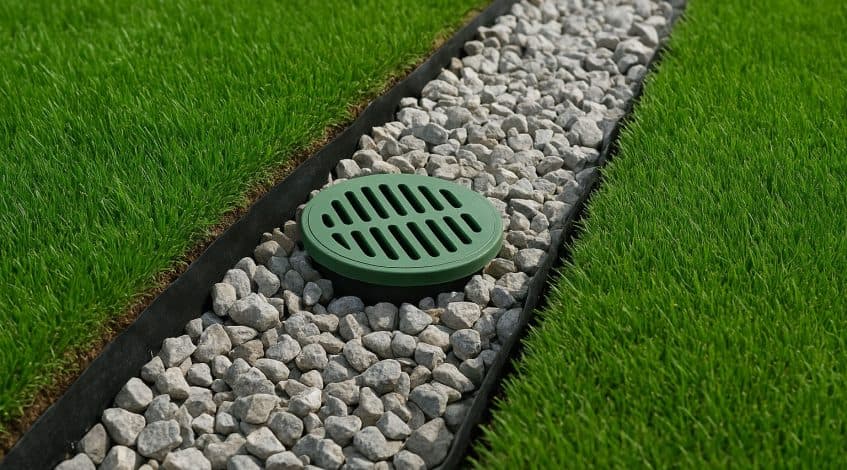
A French drain is a perforated pipe in washed rock, wrapped so the fines do not fill it, sloped to a place the water can actually leave. We do not end a drain in a dry well of hope, and we do not outlet it at the neighbor’s shed.
The trench is deep enough to catch the water you are chasing, which is often the downspout and the wet line along the foundation, not a decorative strip in the middle of the lawn. Surface grading still matters. A drain cannot fix a patio that pitches at the house.
What we look at first
- Where the water shows up, and where it can daylight
- Downspouts that are dumping at the footing
- Utilities before we trench
- Whether the wet spot is a seep that will need more than one line
Downspouts
Solid pipe until it is away from the house, then into the drain if the drain can take the roof. We do not dump a whole roof into a two-inch pop-up in the middle of the lawn and call it drainage.
Maintenance
Silt arrives. Cleanouts and a flush every few years keep the pipe a pipe. Catch basins, if we used one, need the leaves emptied. A drain with no access becomes a dig when it clogs, so we put the access in.
Cost follows the outlet
A short line with an easy daylight is a different job from a line that has to cross a drive, miss a gas service, and reach a ditch fifty feet away. We price it after we see the outlet. We do not quote a per-foot number from the curb.
More from this crew
- French drain installation across Snohomish County
- Retaining walls in Lake Stevens
- Gravel installation in Lake Stevens
- Landscaping in Lake Stevens
- Patio installation in Lake Stevens
- French drain installation in Everett
- French drain installation in Marysville
- French drain installation in Snohomish
Sources for the climate and the water
- USDA plant hardiness map for choosing plants that can take a Snohomish County winter.
- EPA WaterSense on watering less once a lawn or a new planting is established.
- EPA Soak Up the Rain on keeping roof and yard water from becoming someone else’s problem.