Mukilteo drops toward the ferry and the Sound. Salt reaches the lower streets, and the hills above the terminal shed water down through yards that were cut into the slope. A flat inland detail does not survive on these lots. Lots above the ferry and the bluff shed water through the yard. We catch it before it hits the patio and the bank, and we do not outlet a concentrated pipe over a sandy bluff.
Snohomish County · ZIP 98275 · 2020 population 21,246
Hillside water on the way to the Sound
A pipe that daylighted over the lip of a bank is how you start a gully. We spread that water, we tie it to a solid drain the city already has, or we hold it in a line that runs to a safe low point. Sandy soil near the shore will take some water. Clay up the hill will not. We dig the line where the water is actually stuck.
Salt air is hard on cheap fittings. We use solid parts at every turn and we do not bury a leak you will meet again in the basement.
The ground in Mukilteo
Hillside runoff is the job. A patio with a view is also a patio that can send water at the house if the base and the pitch are wrong. We build the drain before the pavers, and we hold the bank with a wall that has rock or drain tile behind it, not a decorative stack sitting on the sod.
Salt-tolerant natives belong on the exposed edges. Pressure washing is how you get the marine film off a walk and a railing; it comes back, so we treat it as upkeep. Lawns on the upper, slightly flatter streets behave more like the rest of the county — clay, moss, shade from big trees — and we maintain them that way. The waterfront lots are a different trade: erosion, wind, and a view you do not want to block with a hedge.
How we do the work
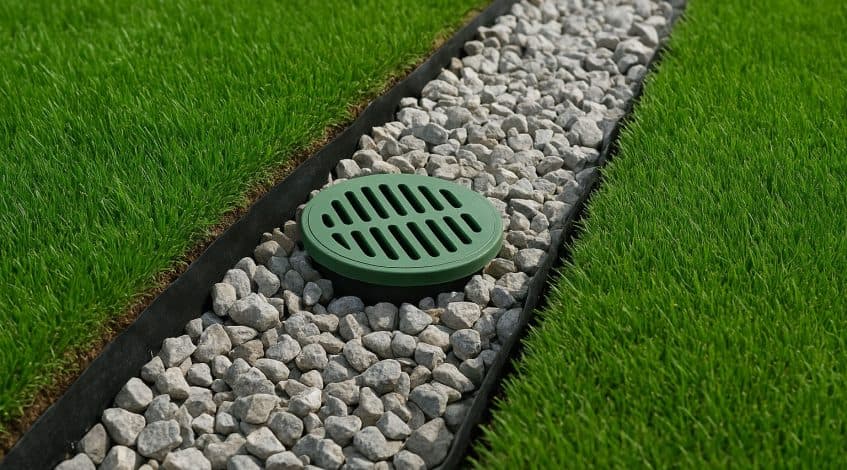
A French drain is a perforated pipe in washed rock, wrapped so the fines do not fill it, sloped to a place the water can actually leave. We do not end a drain in a dry well of hope, and we do not outlet it at the neighbor’s shed.
The trench is deep enough to catch the water you are chasing, which is often the downspout and the wet line along the foundation, not a decorative strip in the middle of the lawn. Surface grading still matters. A drain cannot fix a patio that pitches at the house.
What we look at first
- Where the water shows up, and where it can daylight
- Downspouts that are dumping at the footing
- Utilities before we trench
- Whether the wet spot is a seep that will need more than one line
Downspouts
Solid pipe until it is away from the house, then into the drain if the drain can take the roof. We do not dump a whole roof into a two-inch pop-up in the middle of the lawn and call it drainage.
What the trench looks like
Fabric, washed rock, pipe with the holes oriented the way the detail calls for, then rock, then fabric closed, then soil. The lawn or the bark goes back on top. A trench of pit-run gravel with a pipe tossed in will silt up, and we do not build those.
Maintenance
Silt arrives. Cleanouts and a flush every few years keep the pipe a pipe. Catch basins, if we used one, need the leaves emptied. A drain with no access becomes a dig when it clogs, so we put the access in.
More from this crew
- French drain installation across Snohomish County
- Retaining walls in Mukilteo
- Gravel installation in Mukilteo
- Landscaping in Mukilteo
- Patio installation in Mukilteo
- French drain installation in Everett
- French drain installation in Edmonds
- French drain installation in Mill Creek
Sources for the climate and the water
- USDA plant hardiness map for choosing plants that can take a Snohomish County winter.
- EPA WaterSense on watering less once a lawn or a new planting is established.
- EPA Soak Up the Rain on keeping roof and yard water from becoming someone else’s problem.