Index is a town of 153 people in the Skykomish valley, tucked under steep, rocky walls. Rain comes down those walls in a hurry. Yards are small clearings, and the mountain is the neighbor on every side. Foothill lots fail at the bank, not at the flower bed. The wall has to be heavy, drained, and founded on something that is not fill from the last slide.
Snohomish County · ZIP 98256 · 2020 population 153
The wall is holding the road cut
We dig to competent ground. Setting a wall on the soft stuff that already moved is how you build the next failure. Rock and engineered block both work when the base and the drain are right. The drain daylights to the side, not into the face where it stains and freezes.
Access for boulders is a real constraint on a narrow drive. If we cannot get the stone in, we do not promise stone. Block can be the honest material.
The ground in Index
There is no subdivision playbook here. Access can be a single lane, the soil is thin over rock, and a “backyard” may be forty feet of level ground before the timber starts. Intense runoff is the design constraint. A wall has to be heavy enough to stay put, and a drain has to daylight somewhere that does not wash out the next switchback.
We keep planting short and native. Anything that needs summer water and a gardener will lose. Gravel and hardscape earn their place because they stay usable when the ground is soaked. Pruning and cleanup are how you keep the forest from taking the roof, the line of sight on the drive, and the ditch that is supposed to carry the runoff.
How we do the work
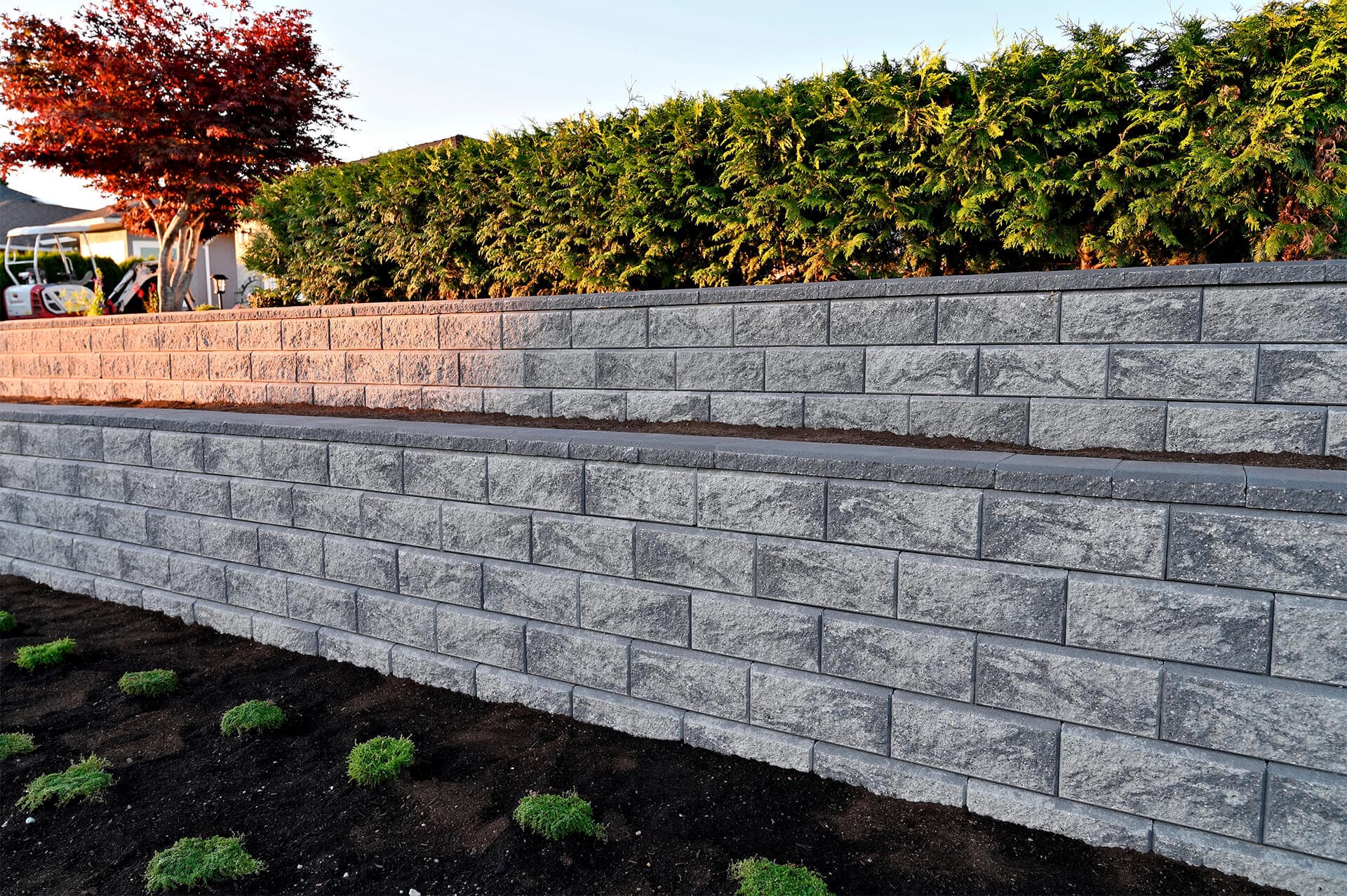
A retaining wall is a structure. The part you see is the block, the boulder, or the timber. The part that keeps it standing is the base, the batter or the geogrid, and the drain rock behind it. We do not stack block on the sod and call it a wall.
Height decides everything. A low garden wall and a wall holding a drive are not the same detail, the same permit, or the same price. We measure the retained dirt, not the face you wish it were.
What we look at first
- Retained height, at the tallest point
- What is above the wall: a lawn, a drive, a house
- Water coming down the slope
- Access for block or for boulders
The base
Compacted rock, buried enough that the first course is not sitting in the organic layer. A wall is not a stack. If the base is soft, we dig out and replace it. There is no fabric or foam that fixes a bad base.
Drainage is part of the wall
Rock behind the face, a pipe at the heel, and an outlet you can see. Weep holes alone, stuffed with the native clay, are not a drain. This is the step that gets skipped on walls that lean.
Block, rock, or timber
Engineered block is predictable and what we use when the height or the permit wants an engineered system. Boulders fit the foothills and the older yards. Timber is a short-life choice in the wet, and we will say how many years you are buying.
More from this crew
- Retaining walls across Snohomish County
- Rock walls in Index
- French drain installation in Index
- Hardscaping in Index
- Patio installation in Index
- Retaining walls in Gold Bar
- Retaining walls in Sultan
Sources for the climate and the water
- USDA plant hardiness map for choosing plants that can take a Snohomish County winter.
- EPA WaterSense on watering less once a lawn or a new planting is established.
- EPA Soak Up the Rain on keeping roof and yard water from becoming someone else’s problem.