The Stillaguamish sits on the north edge of town, and a lot of the yards along the valley floor are old river ground: fertile when it drains, and a slick gray clay when it does not. Winter rain piles up against houses that back toward the Centennial Trail and the river parks, and the lawn stays soft long after the street looks dry. On flat valley ground a trench full of rock becomes a bathtub if it has nowhere lower to go. We find the outlet before we dig the line.
Snohomish County · ZIP 98223 · 2020 population 19,847
Flat clay needs an outlet, not a deeper hole
Clay does not drink a storm. The drain’s job is to intercept water at the foundation and at the low edge of the lawn and carry it to a ditch, a street inlet we are allowed to use, or a lower grade that is still on your property. If none of those exist, we say so and we talk about regrading instead of selling pipe.
We use washed rock and fabric that fits clay, because silt will seal a cheap sock. Downspouts get tied in only if the pipe can take them. A single four-inch line is not a storm sewer for a large roof.
The ground in Arlington
Arlington is a valley town, not a hillside suburb. Lots near the farmland and the trail are often open to the west wind and sit on clay that holds water. After a wet week the soil smears under a boot and the moss moves into any thin spot in the grass. Houses closer to the river have a second problem: the ground is low, so a downspout that just dumps at the foundation has nowhere useful to send the water.
We plan work around that. Drainage goes in before we talk about a patio or a new lawn. Native plantings that actually belong on this floodplain — vine maple, salmonberry, and other understory that can take wet feet — do better than a plant list copied from a drier lot. Gravel paths and low rock work fit the rural edges of town without pretending the soil is something it is not.
How we do the work
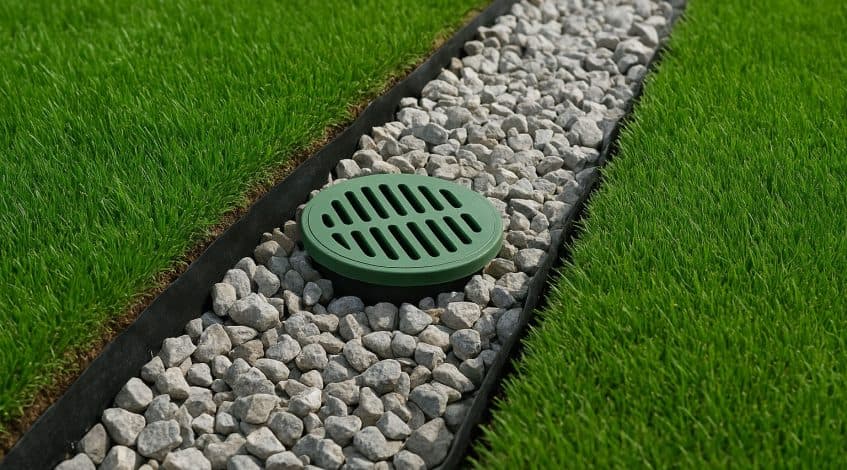
A French drain is a perforated pipe in washed rock, wrapped so the fines do not fill it, sloped to a place the water can actually leave. We do not end a drain in a dry well of hope, and we do not outlet it at the neighbor’s shed.
The trench is deep enough to catch the water you are chasing, which is often the downspout and the wet line along the foundation, not a decorative strip in the middle of the lawn. Surface grading still matters. A drain cannot fix a patio that pitches at the house.
What we look at first
- Where the water shows up, and where it can daylight
- Downspouts that are dumping at the footing
- Utilities before we trench
- Whether the wet spot is a seep that will need more than one line
Maintenance
Silt arrives. Cleanouts and a flush every few years keep the pipe a pipe. Catch basins, if we used one, need the leaves emptied. A drain with no access becomes a dig when it clogs, so we put the access in.
Cost follows the outlet
A short line with an easy daylight is a different job from a line that has to cross a drive, miss a gas service, and reach a ditch fifty feet away. We price it after we see the outlet. We do not quote a per-foot number from the curb.
Downspouts
Solid pipe until it is away from the house, then into the drain if the drain can take the roof. We do not dump a whole roof into a two-inch pop-up in the middle of the lawn and call it drainage.
More from this crew
- French drain installation across Snohomish County
- Retaining walls in Arlington
- Gravel installation in Arlington
- Landscaping in Arlington
- Patio installation in Arlington
- French drain installation in Marysville
- French drain installation in Granite Falls
- French drain installation in Stanwood
Sources for the climate and the water
- USDA plant hardiness map for choosing plants that can take a Snohomish County winter.
- EPA WaterSense on watering less once a lawn or a new planting is established.
- EPA Soak Up the Rain on keeping roof and yard water from becoming someone else’s problem.